Thevenin Equivalent Calculator

Thevenin equivalent calculator
To calculate the Thevenin equivalent voltage, the load impedance is open-circuited. And find an open-circuit voltage across the load terminals. Thevenin equivalent voltage (Veq) is equal to the open-circuit voltage measured across two terminals of load.
What is VTH and RTH Thevenin equivalent Vth?
VTH and RTH can be found, when RLoad is disconnected from nodes a and b. The Thevenin voltage VTH is defined as the open-circuit voltage between nodes a and b. RTH is the total resistance appearing between a and b when all sources are deactivated.
What is VTH equal to?
The Thévenin equivalent voltage is equal to this open circuit voltage: VTh = VAB. (b) If the circuit does not contain any dependent voltage sources or dependent current sources, calculate the equivalent resistance between terminal A and terminal B. RTh is equal to this equivalent resistance.
How do you calculate rth?
d) Find RTH: Remove the source voltage VS and construct the circuit as shown in Figure 5. Use the ALM1000 ohmmeter tool to measure the resistance looking into the opening where RL was. This gives RTH.
What is Thevenin theorem formula?
I = 48 V /( 12 kΩ + 4 kΩ) = 3 mA As there is no current flowing through the 8 kΩ resistor, so there is no voltage drop across it and hence the voltage across the terminals AB is same as the voltage across the 4 kΩ resistor. Therefore, 12 V will appear across the AB terminals. Hence, the Thevenin's voltage, VTH = 12 V.
What is Thevenin theorem with example?
Network theorem that is used for reducing a large, complex linear electric circuit that consists of several voltages or/and current sources and several resistances into a small, simple electric circuit with one voltage source with one series resistance connected across it is termed as thevenins theorem.
What is rth in Thevenin's theorem?
The equivalent resistance Rth is the resistance that the circuit between terminals A and B would have if all ideal voltage sources in the circuit were replaced by a short circuit and all ideal current sources were replaced by an open circuit.
How do you draw a Thevenin equivalent circuit?
In the second step of the process. We determine the feminine equivalent resistance rth by short-
How do you solve the Thevenin and Norton equivalent circuit?
Thevenin and Norton's resistances are equal. Thevenin voltage is equal to Norton's current times Norton resistance. Norton current is equal to Thevenin voltage divided by Thevenin resistance.
How do you solve the problem with Thevenin Theorem?
Steps to Analyze an Electric Circuit using Thevenin's Theorem
- Open the load resistor.
- Calculate / measure the open circuit voltage.
- Open current sources and short voltage sources.
- Calculate /measure the Open Circuit Resistance.
How do you find Thevenin voltage and current source?
So if there's a I - grant going here then we can calculate V Thevenin because I - times 15 ohms will
Why we use Norton's theorem?
The Norton equivalent circuit is used to represent any network of linear sources and impedances at a given frequency. Norton's theorem and its dual, Thévenin's theorem, are widely used for circuit analysis simplification and to study circuit's initial-condition and steady-state response.
How do you find Thevenin resistance with dependent voltage sources?
Dependent Sources and Thevenin's Theorem Thevenin's theorem can be applied when analyzing a circuit with dependent sources. In this case, all independent sources are turned off and the RTh is calculated by applying a current source or voltage source at the open terminal.
What is Thevenin's voltage?
Any combination of batteries and resistances with two terminals can be replaced by a single voltage source e and a single series resistor r. The value of e is the open circuit voltage at the terminals, and the value of r is e divided by the current with the terminals short circuited. Thevenin voltage.
What is difference between Thevenin and Norton theorem?
Thevenin's Theorem utilises a voltage source, while Norton's Theorem uses a current source. Norton's Theorem employs a resistor set in parallel over the source, whereas Thevenin's Theorem utilises a resistor in series. From Thevenin's Theorem, Norton's Theorem can be easily derived.
What is ETH in Thevenin?
Use KCL, KVL and Ohm's Law as needed to calculate the open circuit voltage across the output terminals. This open circuit output voltage is (ETH), the Thevenin voltage source magnitude.
What is Thevenin impedance?
The Thevenin impedance is the impedance looking back from AB with V1 replaced by a short circuit and is therefore a a series-parallel combination. For impedances. Z1 = + j.
What is Norton's current?
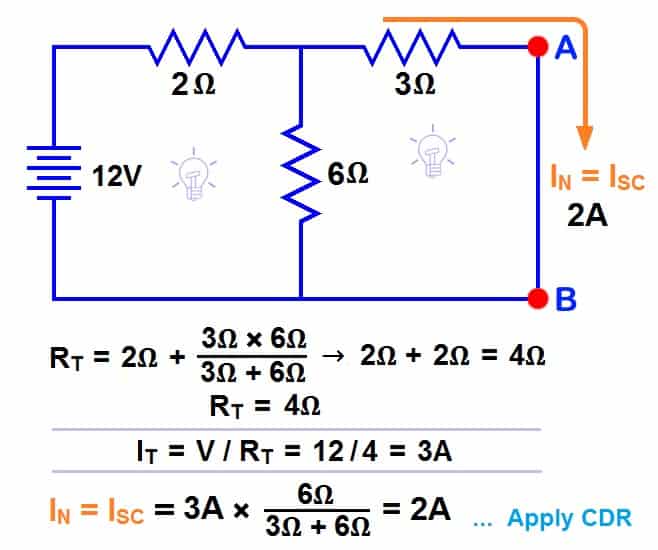
The Norton equivalent circuit represents a general circuit with an independent current source in parallel with the Norton equivalent Resistance. Norton current source ( ) is equivalent to the short-circuit current at the terminal a and b. Norton resistance is th e same as the Thévenin resistance.
What is Max power transfer formula?
Maximum Power Transfer Formula As shown in the figure, a dc source network is connected with variable resistance RL. The fundamental Maximum Power Transfer Formula is. P m a x = V T h 2 4 R T h.
What is Thevenin equivalent resistance?
4 Thevenin's Theorem. Thevenin's Theorem is a technique that allows us to convert a circuit (often a complex circuit) into a simple equivalent circuit. The equivalent circuit consists of a constant voltage source and a single series resistor called the Thevenin voltage and Thevenin resistance, respectively.
10 Thevenin equivalent calculator Images
Ohms Law Calculator Calculate Power Voltage Current Resistance

the voltage across inductance calculator is shown in green and white text
norton equivalent circuit examples With images Electronic circuit

Ohms Law Calculator in 2020 Ohms law Electrical circuit diagram

Voltage Drop Calculator Southwirecom Electrical Switches Electrical

13 ideas de Kirchhoffs Law Circuit Analysis analisis de circuitos

Pin on Clever ideas D

Peak Voltage and Peak to Peak Voltage Calculator RMS Value Calculator

RMS Value Average Value Peak Value Peak Factor Form Factor in AC

Post a Comment for "Thevenin Equivalent Calculator"